Can a smartphone be ethical? Fairphone is trying to answer that question — and changing the mobile industry in the process.
Article Summary
Fairphone is an Amsterdam-based startup building smartphones with ethically sourced materials, fair labour practices, and modular designs that allow users to repair rather than replace. Founded in 2013, it has become a global symbol of what responsible consumer electronics can look like. This is the story of a phone company that dared to ask — and answer — the questions the rest of the industry ignores.
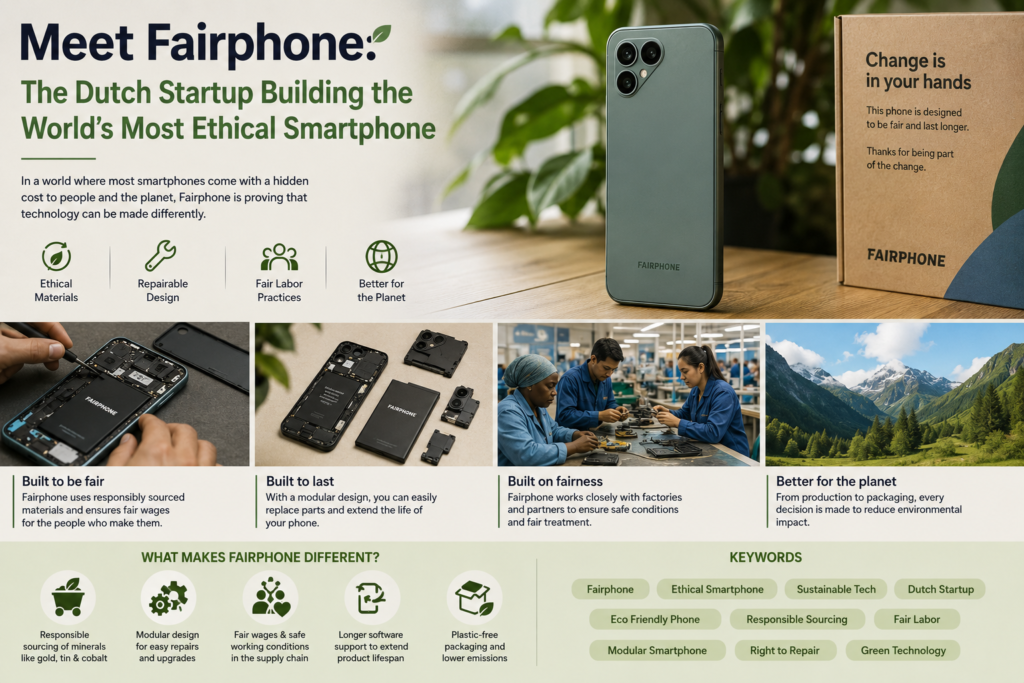
The smartphone in your pocket has a story most manufacturers would prefer you didn’t know. The minerals in its battery may have been mined in conflict zones. The workers who assembled it may have done so in conditions that fall far short of basic labour standards. And when you’re done with it — typically in two to three years — it will likely end up in an e-waste pile, leaching toxic materials into soil and water.
Fairphone, founded in Amsterdam in 2013 by Bas van Abel, decided to make a phone with a different story. A phone that was as ethical as a smartphone could be — starting from the minerals in the ground and ending with the ability to repair and upgrade it rather than throw it away.
The Supply Chain Is the Product
For most technology companies, the supply chain is an operational detail — something managed for efficiency and cost, not something communicated to consumers. For Fairphone, the supply chain is the product.
From the beginning, Fairphone invested in tracing where its materials came from, working directly with mines that could demonstrate fair labour practices and conflict-free sourcing. This is harder than it sounds. The supply chains for the rare earth minerals in smartphones are extraordinarily complex, passing through multiple countries and dozens of intermediaries before a material reaches an assembly facility.
Fairphone has been transparent about both its progress and its failures in this area — acknowledging openly that achieving fully ethical sourcing for every component in a modern smartphone is not yet possible, while committing to continuous improvement and publishing its findings publicly.
The Modular Design Revolution
The second pillar of Fairphone’s mission is repairability. Most modern smartphones are designed to be virtually impossible to repair — components are glued together, screws are proprietary, and replacement parts are either unavailable or prohibitively expensive.
Fairphone took the opposite approach. Its phones are designed to be disassembled with a standard screwdriver. Spare parts for every major component — screen, battery, camera, speaker — are sold directly through the Fairphone website at reasonable prices. Detailed repair guides are freely available.
The result is a phone with an extraordinary lifespan. While the average smartphone is replaced every two to three years, Fairphones are designed and supported to last five to eight years or more. This alone has a profound environmental impact: the production of a new smartphone generates far more carbon than powering it for a year. Extending a phone’s life by several years can more than halve its lifetime environmental footprint.
Small Company, Big Influence
Fairphone is, by smartphone industry standards, a tiny company. It sells a fraction of the units that Samsung or Apple does in a single quarter. But its influence on the industry has been disproportionate to its size.
The company has been a consistent voice in policy debates around the right to repair — the legal and regulatory effort to force manufacturers to make their products repairable. As more consumers and regulators ask difficult questions about e-waste and supply chain ethics, Fairphone’s decade of work in these areas positions it as a reference point and a proof of concept.
The European Union’s push for more sustainable electronics — including requirements for removable batteries and standardised chargers — reflects priorities that Fairphone championed long before they became regulatory requirements.
A Phone for People Who Ask Why
Buying a Fairphone is not just a purchasing decision — it’s a statement. It says you’ve thought about where your technology comes from and what happens to it when you’re done. That’s a small market, but it’s a loyal and growing one.
Fairphone’s success — modest by Silicon Valley standards but meaningful by any measure — proves that there is a market for ethical technology. Not a massive one, perhaps. But enough to sustain a company, influence an industry, and demonstrate that the way we make phones could be fundamentally different from the way we currently do.
In an industry defined by planned obsolescence and supply chain opacity, Fairphone is asking an uncomfortable question: what if your phone could be something you were proud of from start to finish?
About The Author