Every day, restaurants throw away perfectly good food. Too Good To Go built a business — and a movement — around stopping that waste.
📌 Article Summary
Too Good To Go is a Copenhagen-based app that connects consumers with restaurants, bakeries, and supermarkets selling their unsold end-of-day food at a big discount. Since launching in 2015, it has saved hundreds of millions of meals from going to waste across more than a dozen countries. This is how a simple app became one of Europe’s most impactful food startups.
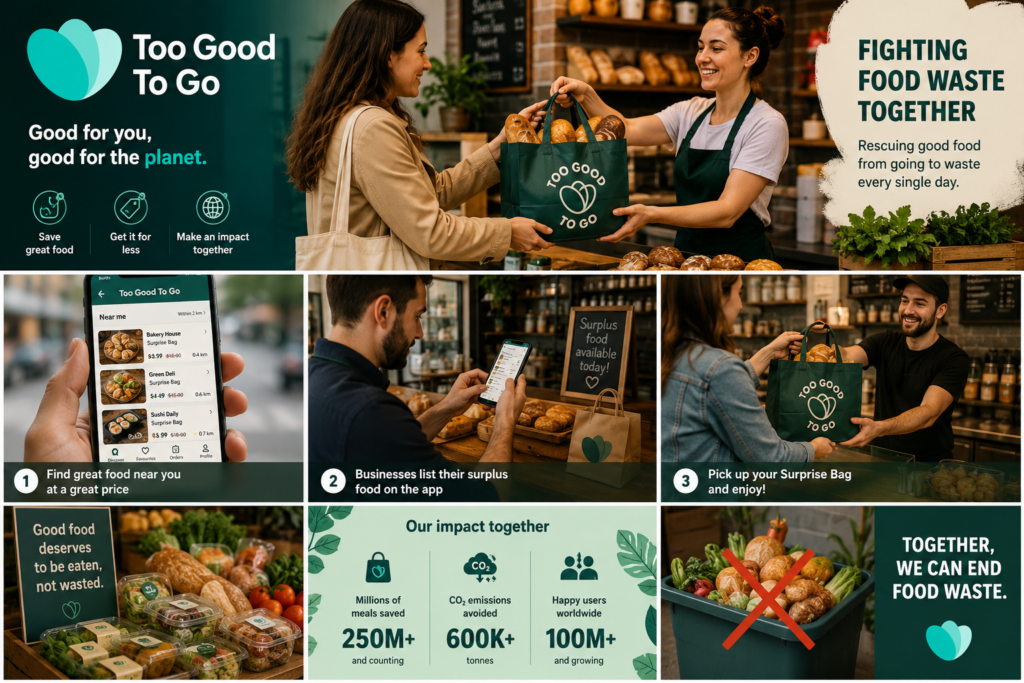
Every evening, restaurants, bakeries, cafes, and supermarkets across the world face the same problem: food that wasn’t sold that day and needs to be disposed of by closing time. In most cases, that food ends up in a bin — perfectly edible meals, freshly baked bread, and prepared salads destined for landfill simply because no customer arrived in time to buy them.
The scale of this waste is staggering. Roughly one third of all food produced globally is lost or wasted — and food waste is one of the largest contributors to greenhouse gas emissions worldwide.
Too Good To Go, founded in Copenhagen in 2015, built a surprisingly simple solution: a mobile app that connects consumers with local food businesses selling their surplus food at a steep discount before closing time.
The Magic Bag Model
The mechanics of Too Good To Go are straightforward. Restaurants, bakeries, and supermarkets list their end-of-day surplus on the app. Customers browse nearby options and purchase what the app calls a “Magic Bag” — a surprise selection of leftover food at a fraction of the original price, typically between one third and one quarter of the retail value.
The surprise element is key. Because customers don’t know exactly what they’ll get, businesses can include whatever they have left without creating expectations around specific items. A bakery might fill the bag with that day’s unsold loaves and pastries. A sushi restaurant might pack it with the rolls prepared for an evening rush that didn’t materialise.
For consumers, it’s a bargain and a small adventure. For businesses, it’s revenue from food they would otherwise throw away. For the environment, it’s millions of meals saved from landfill.
From Copenhagen to the World
Too Good To Go launched in Copenhagen and quickly expanded across Scandinavia, then into the UK, France, Germany, and beyond. By the early 2020s, the app was available across more than a dozen countries and had saved tens of millions of meals from waste.
The growth was driven partly by the app’s genuine utility — saving money on food is a compelling proposition regardless of one’s environmental views — and partly by the company’s success in building a community around the idea of fighting food waste.
Too Good To Go positioned itself not just as a discount food app but as a movement. The company ran educational campaigns about food waste, lobbied for clearer food date labelling, and created content that helped consumers understand the full scale of the problem they were helping to solve.
The Business Behind the Mission
Too Good To Go takes a commission on each Magic Bag sold, creating a straightforward business model aligned with its environmental mission: the more food saved, the more revenue generated. This alignment between commercial and social incentives is one of the most elegant aspects of the company’s design.
For food businesses, the value proposition extends beyond the revenue. Participating in Too Good To Go generates visibility — the app functions partly as a discovery platform, introducing new customers to local restaurants and cafes they might not have found otherwise. Several business owners report that Too Good To Go customers who started as bargain hunters became regular full-price customers after discovering a new favourite spot.
Proving That Doing Good Is Good Business
Too Good To Go’s story is a compelling proof point for a model of entrepreneurship that has become increasingly important: building profitable businesses around solving real social and environmental problems.
The key insight is simple but powerful. Food waste isn’t just an environmental tragedy — it’s an economic inefficiency. When a restaurant throws food away, it loses the revenue that food could have generated. Too Good To Go captures that lost value, shares it with the consumer, and keeps a portion as its fee. Nobody loses. The environment wins.
In a business world often forced to choose between profit and purpose, Too Good To Go demonstrates that the choice doesn’t always have to be made. Sometimes the most sustainable thing a company can do is also the most commercially sensible.
About The Author